Geometry-based alignment and component mirror/alignment
Align components using meaningful geometric frames and distinguish repositioning from creating opposite-hand geometry. Work on a copy first. Record application version, units and active document/configuration. Names below identify the catalogued workflow; they do not claim a particular button layout or verified implementation.
Rotated and mirrored are not the same
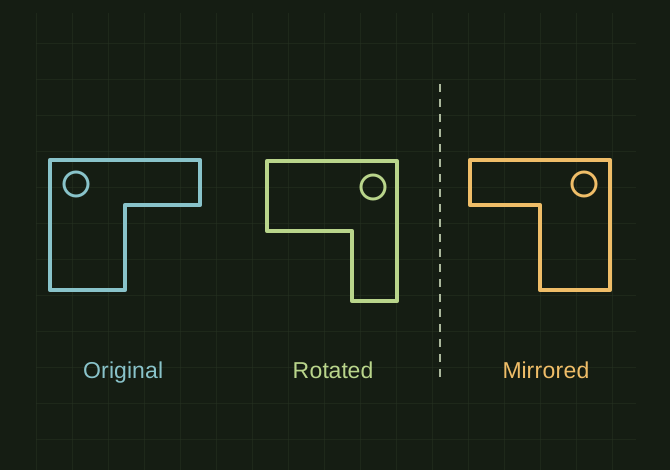 OPEN FULL SIZE ↗
- Frames
- Source and target
- Distinguish
- Repositioning / opposite-hand geometry
- Verify
- Asymmetric features and identity
TECHNICAL NOTES///
Align components using meaningful geometric frames and distinguish repositioning from creating opposite-hand geometry.
GOALRun the first test described in this guide and record the result for geometry-based alignment and component mirror/alignment.
PREPARATION / NOTES
Work on a copy first. Record application version, units and active document/configuration. Names below identify the catalogued workflow; they do not claim a particular button layout or verified implementation.
EQUIPMENT
- CAD / automation tool
- Representative test model
- Measurement or inspection method
STEPS
- Select reference planes, axes or cylindrical faces that define a complete position and orientation.
- Build the source and target coordinate frames with an explicit handedness convention.
- Apply the transform or supported mirror operation, deciding whether a true opposite-hand component is required.
- Check orientation, mates, part identity and asymmetric features after rebuilding.
TROUBLESHOOTING
- Symmetric faces can produce multiple valid-looking alignments. A mirror transform can change handedness; it is not always equivalent to a rotation.
THINGS TO WATCH FOR
Symmetric faces can produce multiple valid-looking alignments. A mirror transform can change handedness; it is not always equivalent to a rotation.
RESULTAn asymmetric test part lands in the expected orientation and retains the correct identity.
DEVELOPMENT HISTORY///
Imported as an independent manifest record; public copy keeps uncertainty visible.
SPECIFICATION///
RELEASED MATERIAL///
An asymmetric test part lands in the expected orientation and retains the correct identity.
The record keeps what is known at this revision. Unfinished tests stay unfinished here.