iLogic AddSimple type-mismatch troubleshooting
Resolve the exact object and method signature rather than guessing argument order from the method name. Work on a copy first. Record application version, units and active document/configuration. Names below identify the catalogued workflow; they do not claim a particular button layout or verified implementation.
Match the argument to the API type
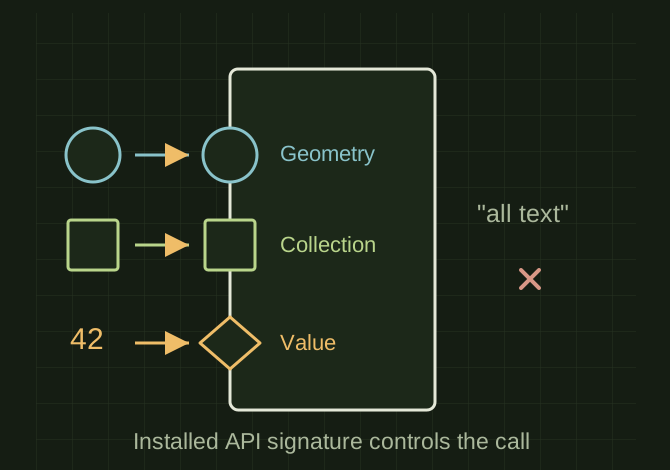 OPEN FULL SIZE ↗
- Identify
- Receiving object and overload
- Check
- Runtime type and units
- Reduce
- One minimal feature call
TECHNICAL NOTES///
Resolve the exact object and method signature rather than guessing argument order from the method name.
GOALRun the first test described in this guide and record the result for ilogic addsimple type-mismatch troubleshooting.
PREPARATION / NOTES
Work on a copy first. Record application version, units and active document/configuration. Names below identify the catalogued workflow; they do not claim a particular button layout or verified implementation.
EQUIPMENT
- Inventor / iLogic
- Representative test model
- Measurement or inspection method
STEPS
- Capture the complete error, failing line, application version and runtime type of the object receiving AddSimple.
- Look up that object’s AddSimple overload in the installed API help/Object Browser; similarly named methods belong to different feature APIs.
- Check each argument’s type, collection type, optional values, units and whether geometry is a native object or assembly proxy.
- Reduce the call to one simple feature in a copied document, then restore the surrounding logic incrementally.
TROUBLESHOOTING
- An ObjectCollection, edge collection, sketch point and numeric expression are not interchangeable. Converting everything to strings can conceal the actual mismatch.
THINGS TO WATCH FOR
An ObjectCollection, edge collection, sketch point and numeric expression are not interchangeable. Converting everything to strings can conceal the actual mismatch.
RESULTThe minimal call succeeds with documented types, and the full rule handles cancellation and invalid selections cleanly.
DEVELOPMENT HISTORY///
Imported as an independent manifest record; public copy keeps uncertainty visible.
SPECIFICATION///
RELEASED MATERIAL///
The minimal call succeeds with documented types, and the full rule handles cancellation and invalid selections cleanly.
The record keeps what is known at this revision. Unfinished tests stay unfinished here.