U225XTHE RECORD REMAINSSEARCH
← RETURN TO INDEX
RECORD LOCATED / 2026.09.01

Bread mixing paddle-to-dough-hook workflow

Use the paddle only to bring a soft mixture together, then let the dough hook do the kneading within the mixer’s capacity. Flour quantity and kneading time come from the parent recipe and actual mixer capacity.

FOOD-003REV A
AI narration using Robert's voice. Bread mixing paddle-to-dough-hook workflow / short introduction.
Open notebook ↗
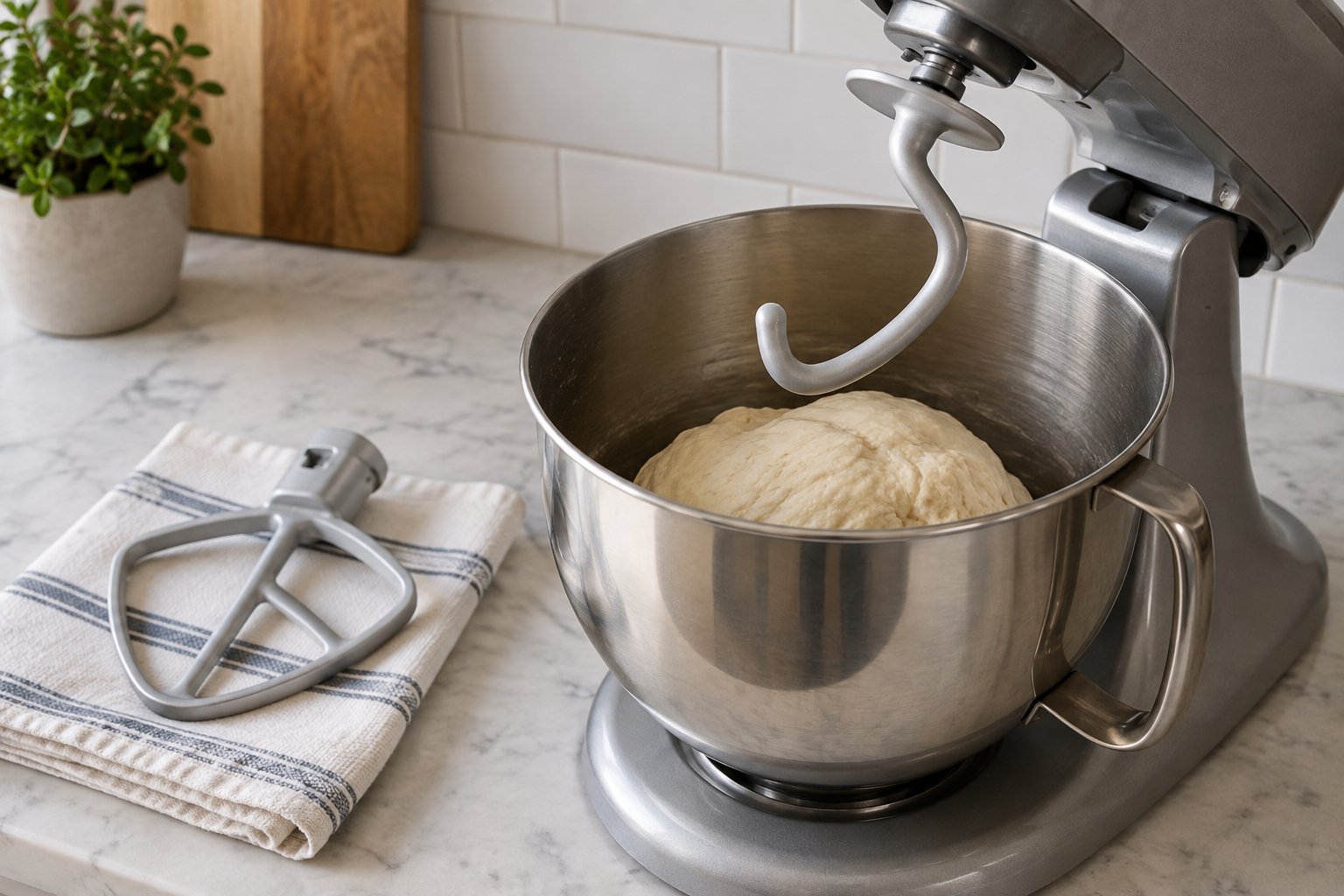
A raised stand-mixer head holds a dough hook above bread dough, while the removed paddle rests beside the bowl.
Illustration of the paddle-to-hook change after the bread mixture becomes cohesive.AI-generated illustration
CLASSIFICATIONFOOD
STATUSStarting Point
MATERIALKITCHEN / RECIPE
DISPOSITIONPUBLIC / STARTING POINT
VIEW FILE ↗

A RECIPE TO MAKEADDED TO THIS RECORD

A complete companion formula from FOOD-001 supplies the measured dough for this technique or troubleshooting record.

Added . This recipe addition is separate from the original notes below; it is not a claim of a tested batch.

Two-loaf French-style sandwich bread

Adapted from the existing FOOD-001 canonical formula without changing its dough quantities. Shaping, oil allowance and storage are newly written practical details; this is not a recovered transcript or a kitchen-tested new version.

YIELD
2 loaves in 9 x 5-inch pans
PREP / WAIT
25 minutes active; 75–105 minutes rising
COOK
28–34 minutes at 375°F; about 2 hours cooling

Ingredients

  • 473 g water, warmed to 105–110°F
  • 7 g active dry yeast
  • 42 g honey
  • 720–780 g all-purpose flour
  • 57 g salted butter, very soft
  • 12 g fine salt
  • 2 tsp neutral oil, for the bowl and pans

Method

  1. Stir the water, honey and yeast in the mixing bowl; wait 5–10 minutes for signs of activity. Grease two 9 x 5-inch loaf pans with half the oil.
  2. Add 720 g flour and the salt. Mix with a paddle on low for about 1 minute, until a shaggy dough forms. Mix in the very soft butter, then stop and install the dough hook.
  3. Knead at the mixer manufacturer’s recommended bread speed for 7–9 minutes, adding the remaining flour only as necessary to obtain a soft, elastic dough that is slightly tacky. Knead by hand if the batch exceeds the mixer’s rated capacity.
  4. Oil a large bowl with the remaining oil, add dough, cover, and let rise for 45–60 minutes or until approximately doubled.
  5. Gently deflate and divide in half. Pat each half into a rectangle about 8 inches wide, roll into a tight log, pinch the seam, and place seam down in a pan.
  6. Cover and proof 30–45 minutes, until visibly puffy and about 1 inch above the rim. Heat the oven to 375°F during the final proof. These pan loaves do not require scoring.
  7. Bake on the center rack for 28–34 minutes, until golden and the center reads 190–195°F. If the surface colors early, loosely tent with foil and continue to the center-temperature target.
  8. Cool 10 minutes in the pans, then turn out onto a rack. Cool completely, about 2 hours, before slicing or bagging.

Notes & storage

  • The 12 g salt is the amount already specified with salted butter in FOOD-001; do not subtract salt from it a second time.
  • Store fully cooled loaves airtight at room temperature for up to 3 days, or slice and freeze for up to 2 months.

Recipe basis & references

TECHNICAL NOTES///

Use the paddle only to bring a soft mixture together, then let the dough hook do the kneading within the mixer’s capacity.

ORIGINAL RECORD / RETAINED NOTESCooking / recipe

GOALRun the first test described in this guide and record the result for bread mixing paddle-to-dough-hook workflow.

PREPARATION / NOTES

Flour quantity and kneading time come from the parent recipe and actual mixer capacity.

INGREDIENTS

  • Exact quantities were not preserved in the manifest entry; add the recovered batch sheet when available.

STEPS

  • Combine liquids and part of the flour with the paddle on low until there are no dry pockets.
  • Stop and switch to the dough hook before the dough becomes too stiff for the paddle.
  • Add remaining flour gradually and knead at the mixer manufacturer’s recommended bread speed.
  • Stop periodically to check temperature and texture; the dough should become cohesive and elastic, with some tackiness rather than dry hardness.

TROUBLESHOOTING

  • Do not use high speed to force a heavy dough to knead faster. A mixer bowl can look sticky before the flour finishes hydrating. Overloading can overheat the motor.

SAFETY / LIMITS

  • Treat this as a public recipe note, not a substitute for current food-safety guidance.

THINGS TO WATCH FOR

Do not use high speed to force a heavy dough to knead faster. A mixer bowl can look sticky before the flour finishes hydrating. Overloading can overheat the motor.

RESULTThe dough stretches without immediately tearing and rises normally; record flour added rather than adding by feel without tracking.

DEVELOPMENT HISTORY///

2026.09.01Rev A

Imported as an independent manifest record; public copy keeps uncertainty visible.

SPECIFICATION///

TypeKitchen / recipe
SourceRecovered notes and content manifest
ValidationNext test should record batch, temperature, time, and result
FocusFermentation, proofing, bake, and cooling

RELEASED MATERIAL///

food-003-public-summary.txtPUBLIC SUMMARY / RECOVERED NOTES
WHERE THIS STANDS

The dough stretches without immediately tearing and rises normally; record flour added rather than adding by feel without tracking.

The record keeps what is known at this revision. Unfinished tests stay unfinished here.
RECORD FOOD-003DISPOSITION / PUBLIC / STARTING POINTBUILD 0.4.17