Printed press-brake hem/round profile
Use a CAD section to explore the required hem or rounded form before considering a printed tool. Hemming, air bending and bottoming have different contact conditions and force demands.
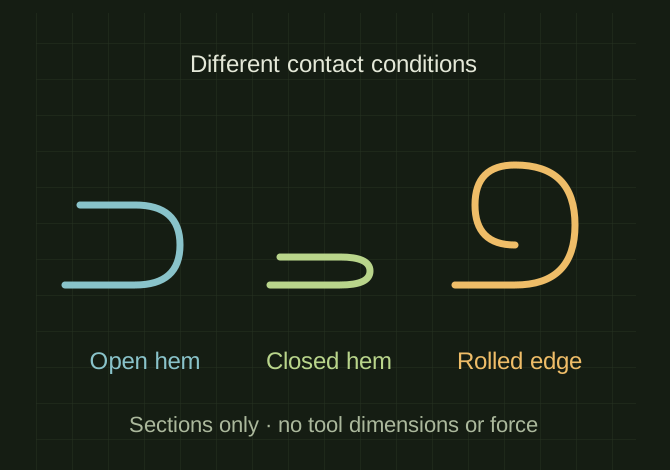
Open hem, closed hem, rolled edge
 OPEN FULL SIZE ↗
- Forms
- Open hem / closed hem / rolled profile
- Check
- Approach and withdrawal interference
- No inferred
- Machine stroke or capacity
TECHNICAL NOTES///
Use a CAD section to explore the required hem or rounded form before considering a printed tool. Hemming, air bending and bottoming have different contact conditions and force demands.
GOALRun the first test described in this guide and record the result for printed press-brake hem/round profile.
EQUIPMENT
- FDM printer / slicer
- Slicer project
- Calipers or inspection method
MATERIALS
- Material requires confirmation
STEPS
- Measure the desired finished cross-section, material thickness, clearance and flange length. Distinguish an open hem from a closed hem or a rolled profile.
- Model the sheet and tool sections together, including the approach and withdrawal path. Check for trapped geometry and interference through the entire stroke.
- Print an unloaded profile mock-up to check fit and handling. Keep this geometry-check specimen separate from any tooling authorized to carry load.
- For an actual forming trial, obtain a process-specific load and tooling review; document each forming stage independently.
TROUBLESHOOTING
- A tool that performs a simple V-bend cannot be presumed suitable for flattening a hem. Contact pressure can rise sharply as a hem closes. Do not infer a machine stroke or capacity from the appearance of the print.
SAFETY / LIMITS
- Use qualified judgment and current manufacturer or code guidance for safety-critical work.
THINGS TO WATCH FOR
A tool that performs a simple V-bend cannot be presumed suitable for flattening a hem. Contact pressure can rise sharply as a hem closes. Do not infer a machine stroke or capacity from the appearance of the print.
RESULTThe deliverable is a section drawing, interference review and test plan with measured outcomes if testing occurs.
DEVELOPMENT HISTORY///
Imported as an independent manifest record; public copy keeps uncertainty visible.
SPECIFICATION///
RELEASED MATERIAL///
The deliverable is a section drawing, interference review and test plan with measured outcomes if testing occurs.
The record keeps what is known at this revision. Unfinished tests stay unfinished here.