Press-brake test dies in PP
Polypropylene is a candidate for low-marking tooling experiments, but its compliance and creep make dimensional control a major question. Prototype process reference only. Exact PP grade and machine-compatible printing profile remain unconfirmed.
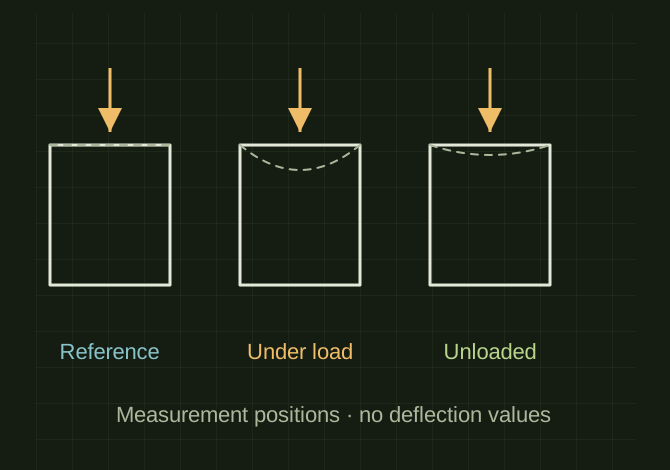
Deflection versus residual change
 OPEN FULL SIZE ↗
- Material
- PP
- Measure
- Loaded deflection / residual deformation
- Also record
- Time under load and cycles
TECHNICAL NOTES///
Polypropylene is a candidate for low-marking tooling experiments, but its compliance and creep make dimensional control a major question.
GOALRun the first test described in this guide and record the result for press-brake test dies in pp.
PREPARATION / NOTES
Prototype process reference only. Exact PP grade and machine-compatible printing profile remain unconfirmed.
EQUIPMENT
- FDM printer / slicer
- Slicer project
- Calipers or inspection method
MATERIALS
- PP
STEPS
- Define whether the part is a contact pad, supported insert or complete die; these impose different stresses.
- Measure the required working profile and design a mechanically retained, supported sample. Do not rely on a smooth PP-to-holder adhesive joint without a validated bonding method.
- Use the exact PP manufacturer’s temperature and build-surface instructions. Print a short dimensional coupon before a large die; PP adhesion and shrinkage can dominate the result.
- Under the approved test setup, measure loaded deflection and residual deformation after unloading. Repeat only within the approved test envelope.
TROUBLESHOOTING
- PP is not a drop-in replacement for stiff carbon-fiber nylon. A part that springs back initially may creep with repeated loading. Heated-bed settings, shrink compensation and joint designs are product-specific.
SAFETY / LIMITS
- Use qualified judgment and current manufacturer or code guidance for safety-critical work.
THINGS TO WATCH FOR
PP is not a drop-in replacement for stiff carbon-fiber nylon. A part that springs back initially may creep with repeated loading. Heated-bed settings, shrink compensation and joint designs are product-specific.
RESULTReject a tool that shifts, spreads, loses profile or cannot repeat the required angle. Record time under load as well as cycles.
DEVELOPMENT HISTORY///
Imported as an independent manifest record; public copy keeps uncertainty visible.
SPECIFICATION///
RELEASED MATERIAL///
Reject a tool that shifts, spreads, loses profile or cannot repeat the required angle. Record time under load as well as cycles.
The record keeps what is known at this revision. Unfinished tests stay unfinished here.