Afanc
The Afanc inhabits several Welsh stories, from a lethal cave to a lake that must release its monster. The landscape preserves its traces, while the written tradition contains important later alterations.
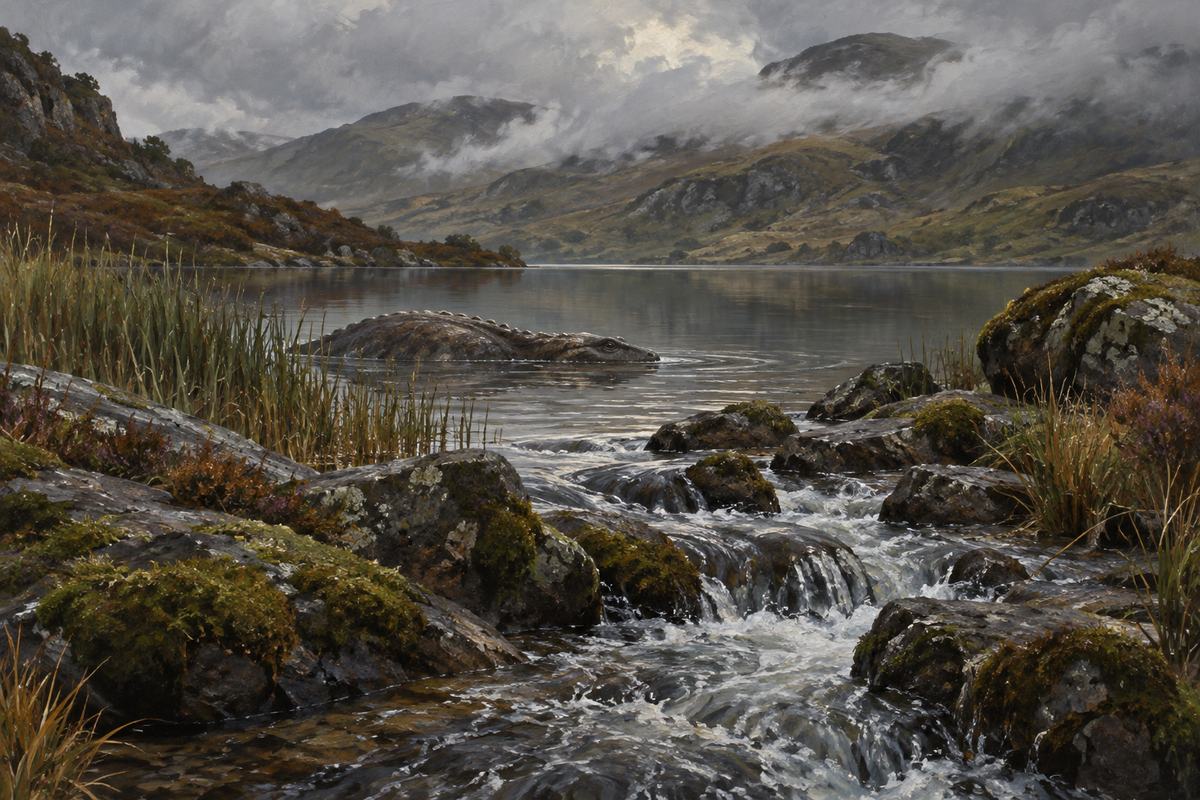
The account
At Llyn Barfog, one telling gives Arthur the task of hauling the Afanc from the water. His horse’s effort leaves a mark in stone, remembered nearby as Carn March Arthur. Other versions assign the work to Hu Gadarn and his powerful oxen. Far from a single animal biography, the Afanc also appears in the tale of Peredur as a murderous cave-dweller. Across these stories, the threatening creature occupies a place people cannot easily reach and must somehow be drawn beyond its protection.
Following the trail
Coflein, the Welsh national monuments record, documents the lake traditions and their sources. It also warns that the flood-and-oxen version was popularized through a nineteenth-century collection containing material largely invented by Iolo Morganwg. That version should not be advertised as an untouched ancient account. The older literary creature, the localized Arthur story and later antiquarian additions have distinct histories, none of which establishes a captured lake animal.
Why it stays with us
The stone hoofprint brings an enormous struggle down to one small surface. A visitor can see the place where the story says force was applied. It is a compelling way for a landscape to hold a narrative, even when the narrative’s versions do not agree.