Each-Uisge
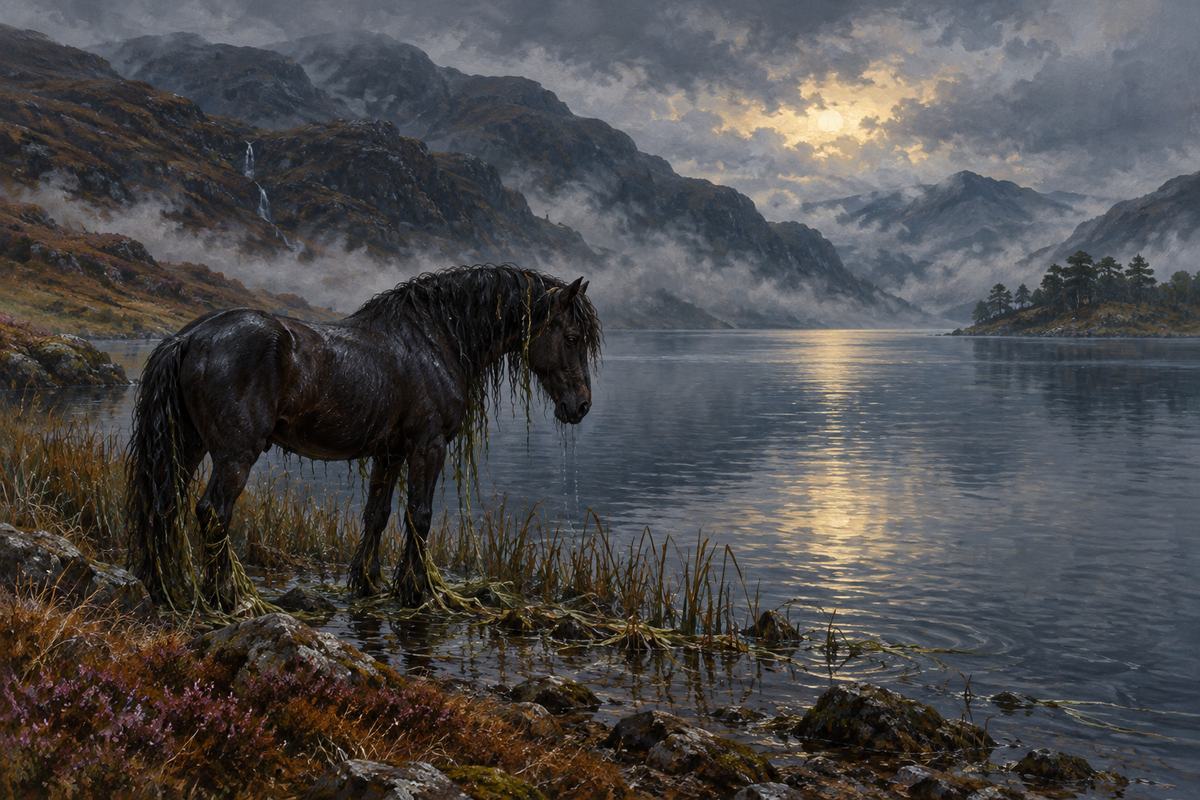
The each-uisge can look like an ordinary horse beside a Highland loch. In collected Gaelic stories, a little waterweed may be the only warning before a helpful ride becomes something else.
The account
In a story collected by John Gregorson Campbell, a traveler near Cru-Loch on Mull finds a saddled horse quietly feeding beside the water. A ride home seems possible until he notices water plants around its feet and leaves it alone. A stranger then catches up with him and reveals the horse’s other nature. Elsewhere in Campbell’s collection, children climb onto a horse whose back lengthens to carry them; it runs into the loch with its riders still attached. These are tellings of the each-uisge, the water-horse.
Following the trail
Campbell’s 1900 collection preserves named places, variants and his own comments about the stories’ functions. It is a source for Scottish Gaelic folklore, not evidence of verified drownings caused by a shape-changing animal. His water-horse chapter should also not be treated as a universal description of every Celtic water spirit. The Cru-Loch traveler and the children belong to separate tales, not successive episodes in one encounter.
Why it stays with us
The creature is most alarming when it offers something useful. A saddle promises an easier journey; a quiet animal seems safe to approach. The small trace of its watery home is what breaks the disguise, turning a roadside convenience back into an unknown depth.