U225X / STRANGE FILES
Symmes's Hollow Earth: An Entrance at the Poles
United States; imagined polar regions / 1818–1820s
John Cleves Symmes publicly proposed that Earth held habitable inner worlds accessible through its poles. His unsuccessful geography belonged to a real campaign for exploration, where unmapped territory made extraordinary ideas tempting.
Documented historical theory; physical claim disproven
The account
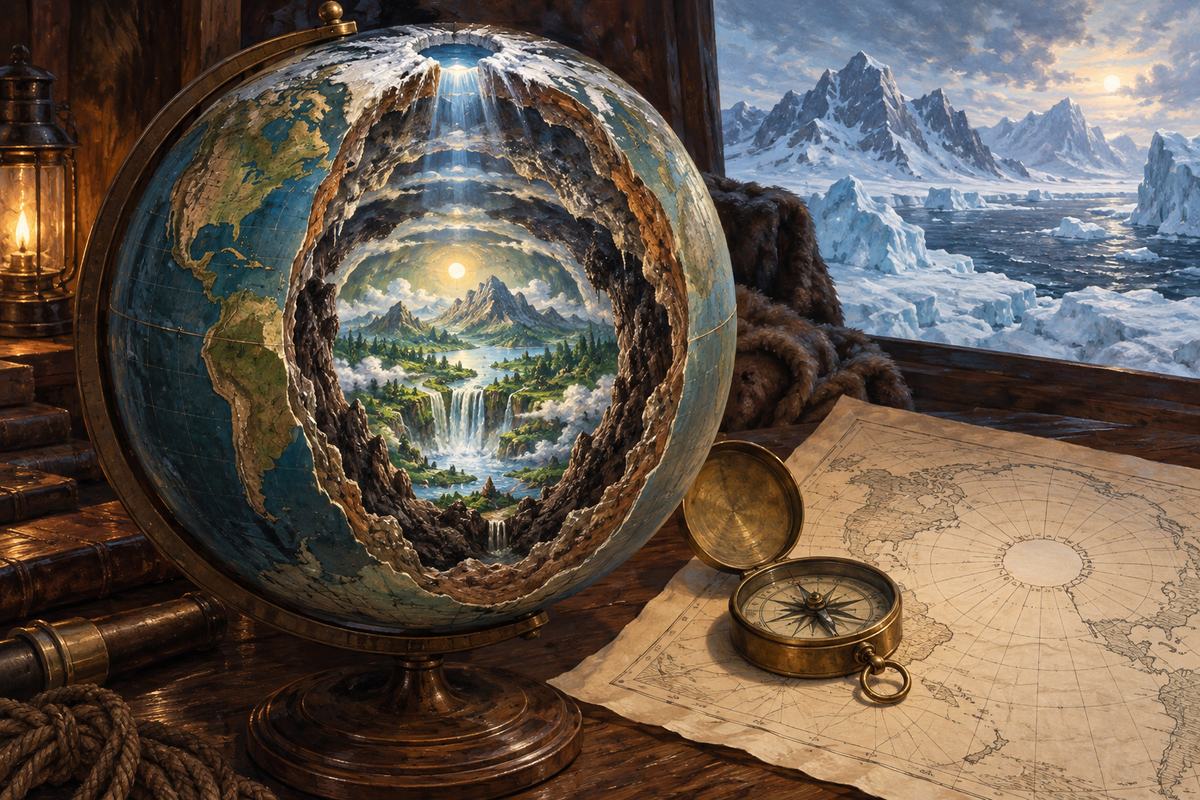
In April 1818, John Cleves Symmes announced that Earth was hollow, inhabited within and open at the poles. He offered to explore it if supporters would help him. His proposal imagined nested worlds inside the familiar one, turning the farthest edges of the map into doorways. A polar expedition would therefore do more than reach a remote latitude: it would cross the boundary between the known surface and an entire concealed geography.
Following the trail
Symmes's surviving circular records the claim in his own words. Smithsonian's history of the United States Exploring Expedition also describes his advocacy and belief in polar openings. These sources establish the proposal and its connection to exploration culture. They do not validate its physical model. The inhabited concentric spheres belong to a discarded theory, not a discovered interior landscape.
Why it stays with us
This mystery came with an invitation to travel rather than an accusation that someone had hidden the truth. The polar blanks on contemporary maps gave the imagined entrances room to exist. Symmes's story captures a particular kind of historical suspense: the moment when a place beyond direct observation seems large enough to contain almost any possibility.