Kraken
The Kraken’s arms reach across Scandinavian sea stories and old ship engravings. Real giant squid give the legend an anatomical foothold without proving the enormous ship-destroyer of the tales.
The account
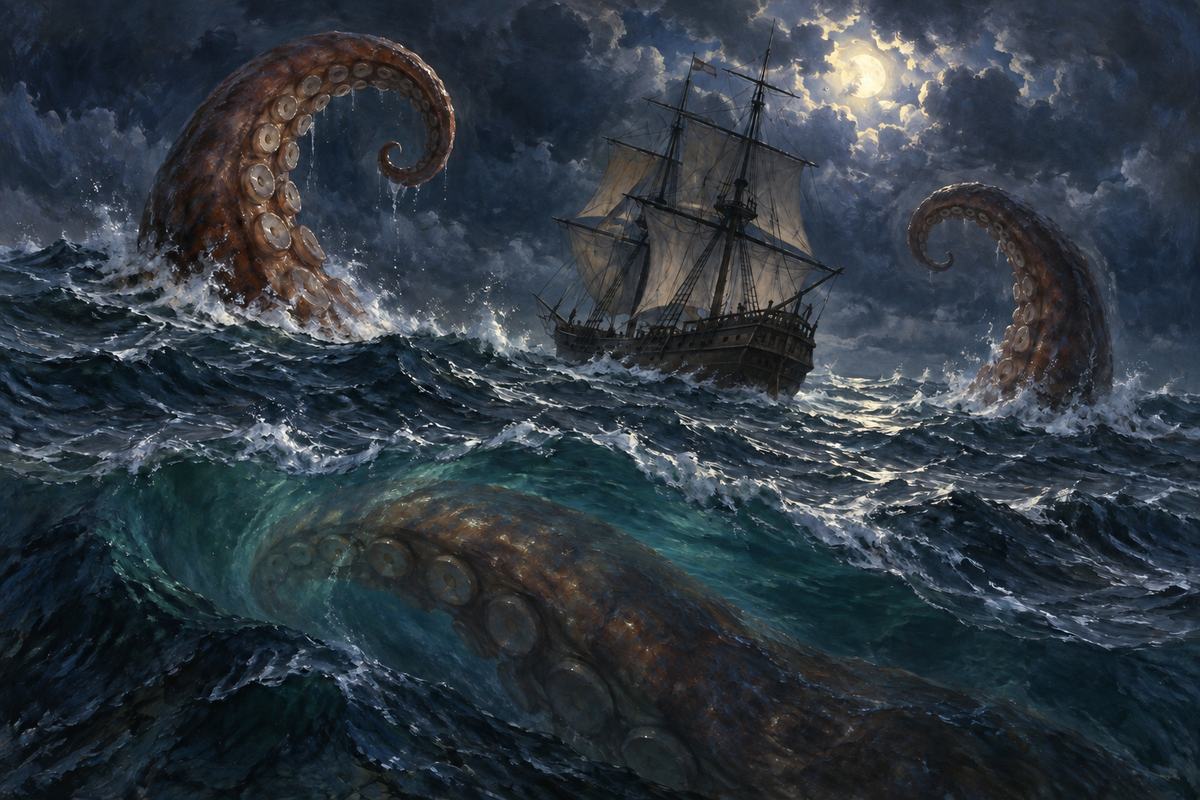
The Kraken comes from Scandinavian maritime folklore, where a vast tentacled creature threatens ships and the people aboard them. In an 1801 illustration by naturalist Pierre Denys de Montfort, a colossal octopus clasps a vessel as if the rigging were something it could gather into itself. The image captures the legend’s central reversal: a ship built to command the sea becomes a small object inside another animal’s reach. Later literature gave those arms an even wider ocean to occupy.
Following the trail
Natural History Museum specialists suggest that large squid, octopuses and their unfamiliar washed-up remains helped inspire such stories. Giant squid are real animals studied from specimens and observations; that fact does not authenticate a specific account of a Kraken destroying a ship. The museum presents connections between natural history and folklore as explanations to consider, not a discovery that every old sea monster was the same species.
Why it stays with us
The Kraken unsettles ordinary ideas of scale. A sailor may know the length of a mast or the strength of a hull, yet the story makes both inadequate measures. Its grip closes around the tools that were supposed to make the open water manageable.