U225X / STRANGE FILES
Atlantis: The Island at the Edge of Plato's Story
Ancient Greek literature; legendary Atlantic island / Plato's Timaeus and Critias, 4th century BCE
Plato describes a wealthy island power, a war with ancient Athens and a catastrophic disappearance. The original dialogues preserve a compelling literary account, while claims of a confirmed lost civilization remain unestablished.
Ancient philosophical narrative; historical island empire not independently established
The account
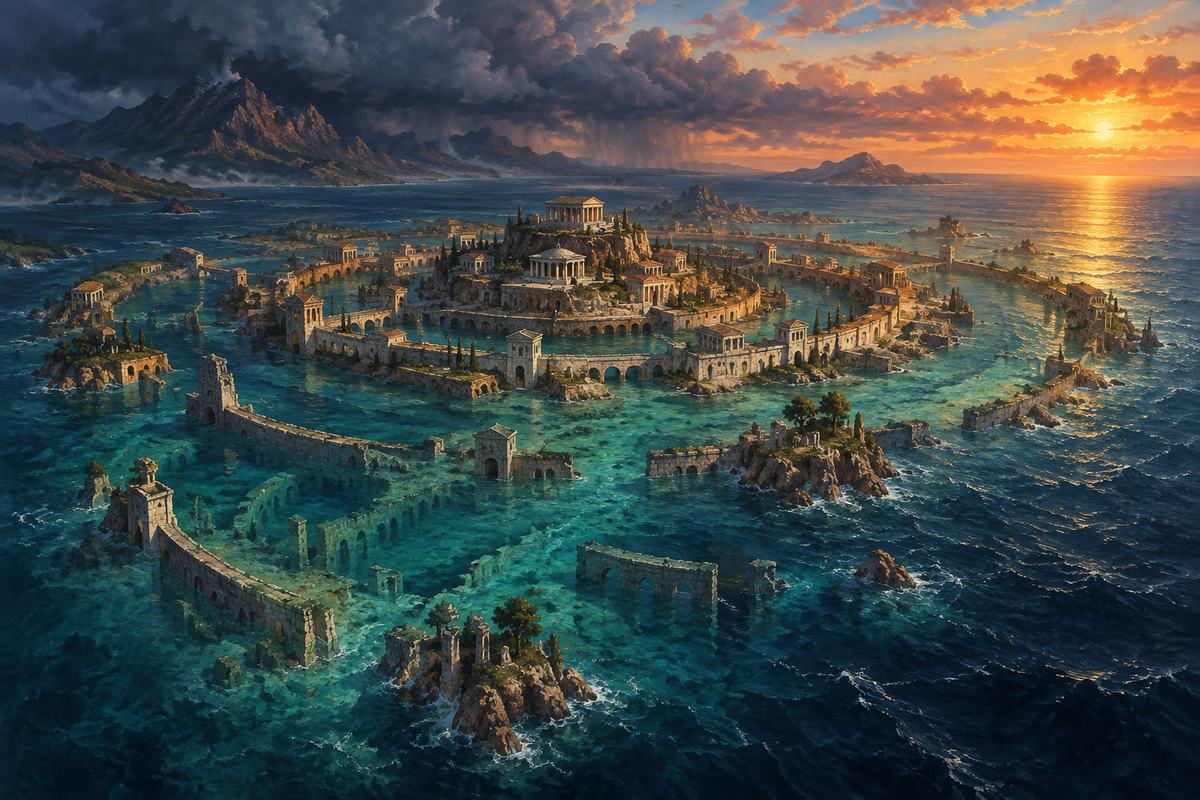
Beyond the Pillars of Heracles, Plato's speakers place an island empire with remarkable wealth and power. In Critias, rings of land and water surround its center, and the descendants of Poseidon rule its divisions. In Timaeus, the island's defeat and destruction are recalled as events from a remote past: earthquakes and floods overwhelm it in a single disastrous interval. What had seemed immense is left beneath the sea, its memory resting in a chain of narrated recollection.
Following the trail
The traceable starting point is Plato's fourth-century BCE dialogues. Within them, Critias attributes the account to Solon and Egyptian priests; that attribution is part of Plato's text, not an independently recovered Egyptian archive. The dialogues are genuine ancient sources for the Atlantis story. They do not themselves authenticate a particular modern proposed location or provide excavation evidence for the island empire. Their detailed geography must be read alongside their discussions of virtue, power and political order.
Why it stays with us
The place feels discoverable because its description is concrete, yet its transmission remains embedded in conversation. There is another remarkable absence: Critias ends as Zeus prepares to address the gods. The surviving work leaves the expected speech unwritten or lost, allowing the silence around Atlantis to begin inside the ancient source itself.