The Lesser Key: Seventy-Two Names in the Dark
The Goetia arranges seventy-two spirits into ranks, appearances and supposed abilities. Its imposing catalogue belongs to an early modern compilation assembled from older materials and attributed long afterward to Solomon.
The account
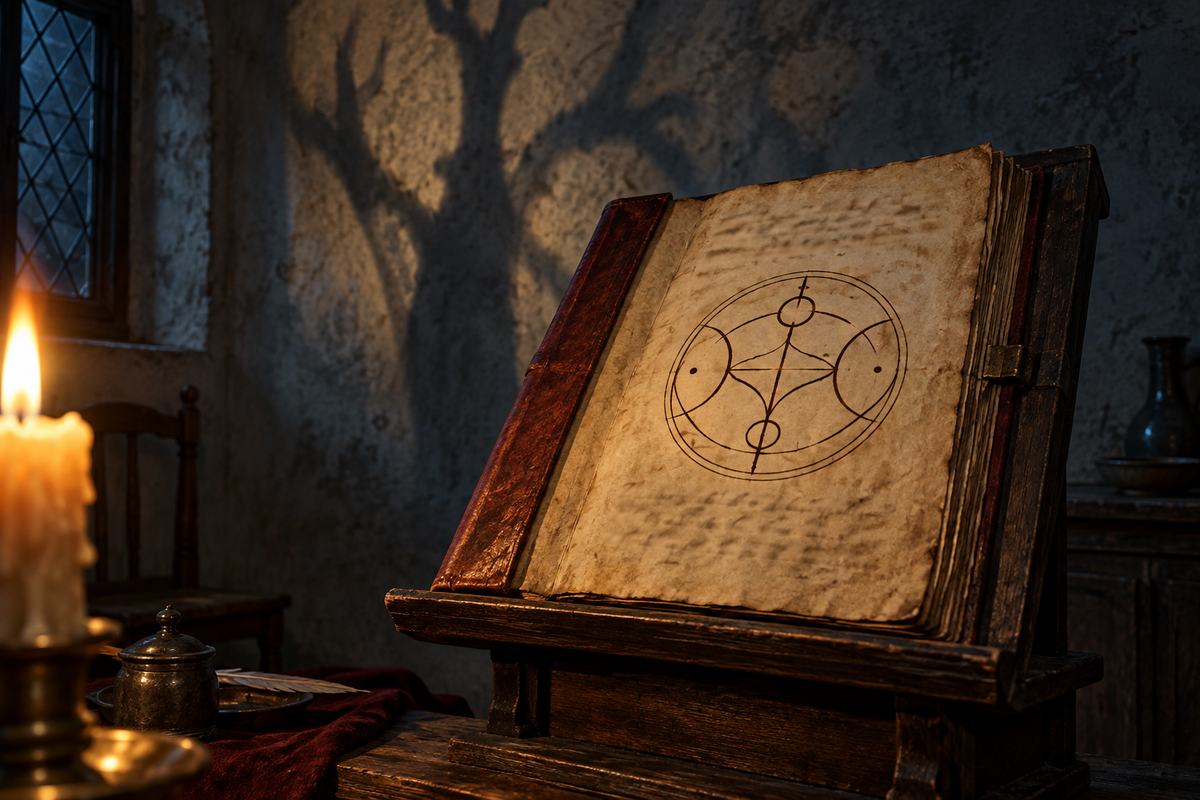
The Goetia does not leave its spirits shapeless. It assigns them names and ranks, describes how they appear and lists what they supposedly know. The reader meets a strange court of kings, dukes and other powers, each accompanied by a sign. Around that catalogue sit protective figures and commands. The imagined encounter has the form of an audience with a dangerous official whose rules must be understood before he arrives.
Following the trail
The Goetia is the first part of the Lemegeton, also called the Lesser Key of Solomon. Joseph H. Peterson's edition transcribes seventeenth-century manuscript Sloane 3825 and compares related copies. He traces much of the spirit catalogue through earlier European demonological writing and translation. The collection's seventy-two entries are therefore evidence of textual compilation, not a register found in Solomon's palace. The familiar Mathers–Crowley printed Goetia appeared in 1904, adding another layer to its transmission.
Why it stays with us
The book's eerie precision makes the impossible feel almost administrative. A frightening presence becomes something with an office, a seal and a place in a hierarchy. Comparing the manuscripts reveals a second kind of uncertainty: names change, copying introduces errors and later editors reshape what readers may mistake for an unbroken ancient instruction.