A conversation-specific public summary of 3d printed whistling card, distilled from the supplied export. The detailed excerpts remain available in the released note file.
CHAT-0035REV EXPORT-03
AI narration using Robert's voice. 3D printed whistling card / short introduction.
Conversation-specific knowledge extracted from the 3d printed whistling card discussion.
EXTRACTED KNOWLEDGE / HOW-TOFROM CONVERSATION
QUESTION / CONTEXTI want to 3d print a playing card that whistles really good when you throw it will you help me with ideas
IMPORTANT GUIDANCE
--
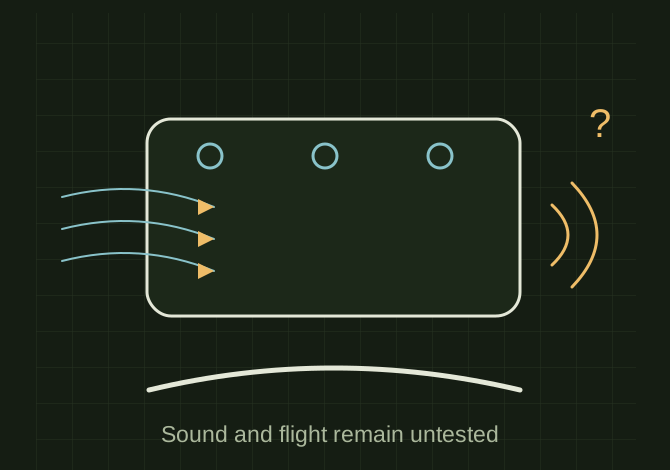
Slight airfoil profile: Instead of a flat card, curve it gently (like a Frisbee). This will help keep it from tumbling. You could model it as a thin rectangle with just a 1–2 mm bow.
Rounded corners: Keeps it safer and less likely to catch wind unevenly.
Thickness: A standard playing card is ~0.3 mm, but you’ll want closer to 1–2 mm for 3D print strength without being too heavy.
Circular holes near the edges: Place a row of holes offset from the centerline. As air rushes through them, it creates turbulence and whistling.
Flute-style slot: Add a small angled channel (like a whistle mouthpiece) at one or two corners. This can produce a sharper whistle than round holes.
Multiple tones: Vary hole size/spacing so you get a “multi-note” whistle as it flies.
Vented lattice: Instead of a solid center, cut triangular or hexagonal lattice holes. This reduces weight and creates “whooshing” that could amplify the whistle.
Extracted from the conversation’s assistant responses and edited for public clarity. See the released note for additional redacted excerpts.
DEVELOPMENT HISTORY///
2025.09.29EXPORT-04
Matched to the supplied export; key guidance is surfaced separately and the raw transcript remains unpublished.
 OPEN FULL SIZE ↗